
 This is our version of a sunny day. I was thinking of the Seasonal Affective Disorder SAD, we have not only the absence of sun but the absence of an entire season of summer. I was in my favorite little Italian store, Mina, just across the border in Ponte Tresa, Italy, where while my order of Parma dolce was being sliced, the 4 clerks behind the counter were exchanging comments with me about, of course, the weather. One jocularly asked how it was at my home, knowing that I live in the green and verdant Malcantone, Swiss German guidebooks call it the ‘green lung’ of the Lugano area, saying laughingly, “it must be like Ireland”. Another sourly said, “in July it rained 24 out of 31 days”, while another jumped in to say, “and now (August 3) it’s 3 out of 3, great, we’re starting out well.” Even for this month, I don’t remember one whole day where we would wake up in the morning to sunshine and end in the evening without rain. But we are lucky; our home has not suffered flooding, our village has not been threatened by mudslides. On Wednesday, as we were driving back down one set of mountains, in the Bernese Oberland from Gstaad, another mountain side in the Engadine was hit by a mudslide just as the famous Glacier Express train was coming by from St. Moritz. Eleven people were injured, 5 seriously. But as all the reports said, there was “Gluck in Ungluck”, luck in bad luck, because our wonderful Swiss vegetation saved those cars from falling into the deep, rushing waters at the bottom of that precipice. Three railway cars were pushed from the tracks, and one was pushed completely off and was left dangling in the alpine tree layers which caught and saved those passengers.
Monthly Archives: August 2014
Happy Birthday Switzerland
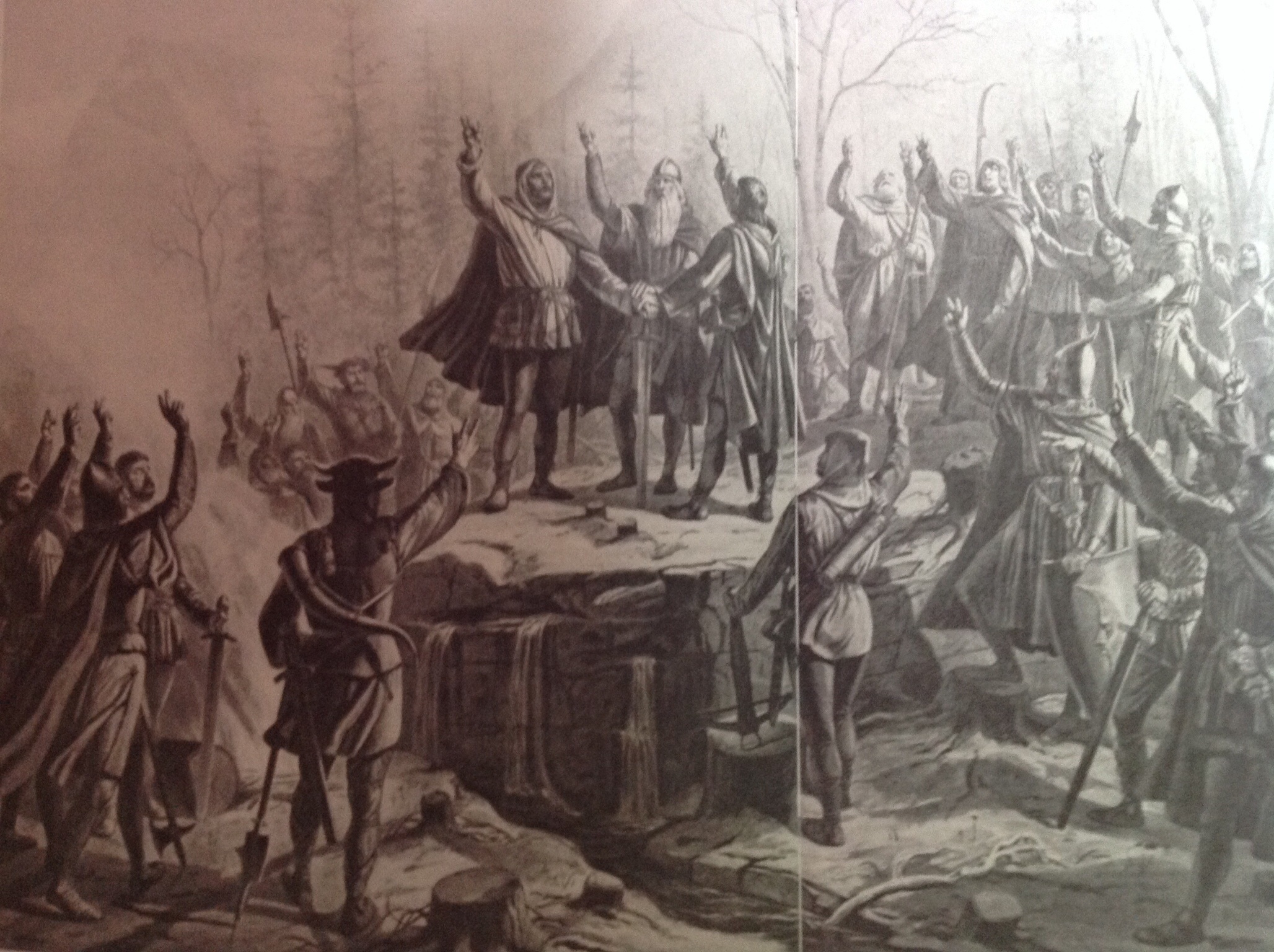
Leaders of Uri, Schwyz and Unterwalden pledging alliance to a new Swiss Confederation, August 1, 1291
Illustration from Tableaux d’Histoire Suisse, Charles Jauslin
Switzerland celebrated its 723rd Birthday yesterday. The origins of the Swiss Confederation date from August 1, 1291, when the leaders of the 3 cantons of Uri, Schwyz and Unterwalden came together against the Hapsburg rule, forming an Everlasting League against foreign subjugation, to be a ‘one and only nation of brothers’. The legend of the Swiss national hero, William Tell, comes from this period.
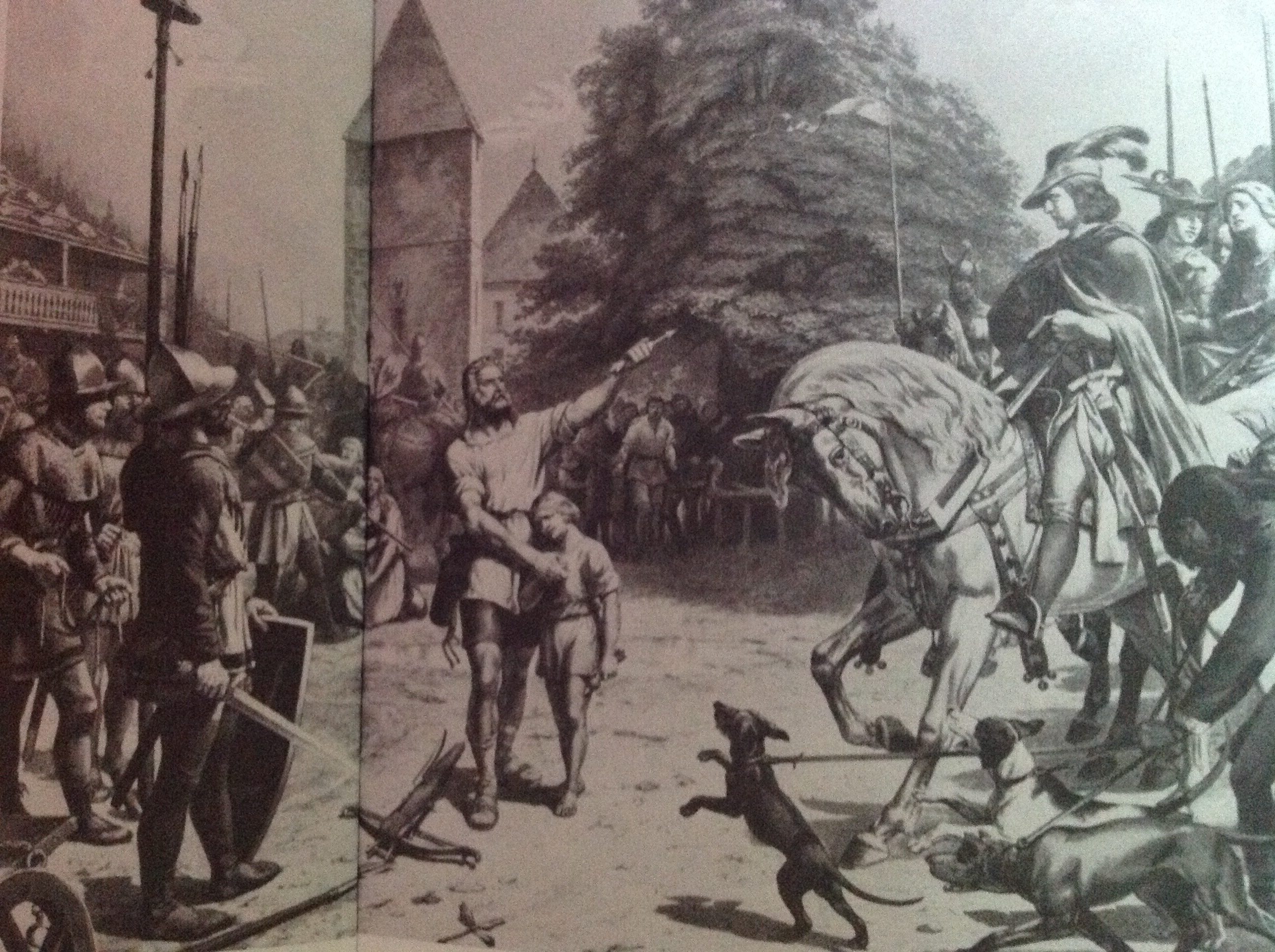
Tableaux d’Histoire Suisse
The story is that William passed by the symbolic Hapsburg hat, placed on a pole in the main square as a representation of Austrian power, without the obligatory reverential bow. This irreverent act so enraged the local bailiff Gessler that he ordered Tell, a noted hunter, to shoot an apple off his son’s head as punishment for such provocation. Tell aimed his crossbow, fired, and split the apple in two with his arrow, saving his son. He later shot an arrow through Gessler, as well. Tell’s legend is a strong part of Swiss identity, a common man standing up for his rights. There is a monument dedicated to him in Altdorf, Uri, and his likeness adorns the back of our largest coin currency, the 5 franc piece. For many years, Tell’s crossbow was the symbol for Swiss quality goods.
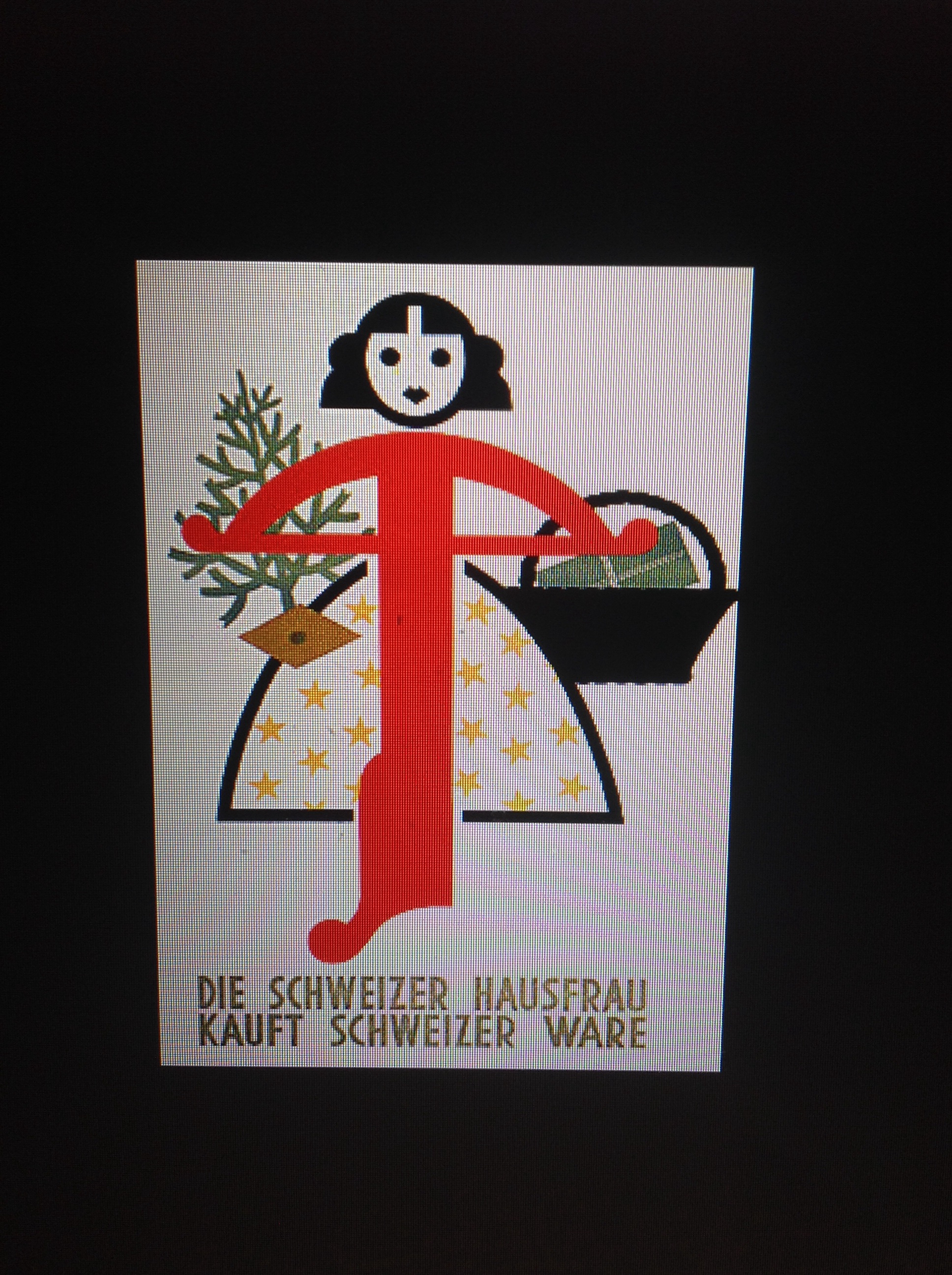
Swiss Housewives 1930s Advertisement
“Tell in Everyday Life” by Ueli Windisch
This ad was done in the 1930s by an association of Swiss housewives to promote Swiss goods during the economic crisis. Much later, a Levi campaign which used a different male image for each country, choose William Tell as its Swiss subject.

“Tell in Everyday Life”, Ueli Windisch
 Finally Home Switzerland